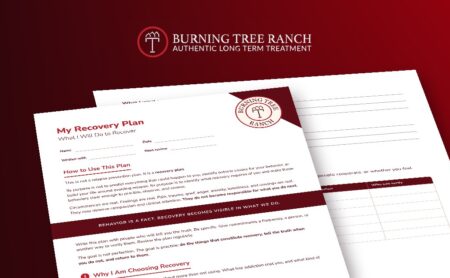

A relapse prevention plan is a written plan that lists a person’s triggers, warning signs, and high-risk situations, along with what they will do when those show up.
At Burning Tree, we write recovery plans instead. A recovery plan lists what recovery requires a person to do every day and every week, and the family writes one too. Our free workbook below walks through both.
I have worked with people who know almost everything there is to know about relapse. They know the terminology, warning signs, meetings, sponsor numbers, and what they’re supposed to do when they want to use. Some have been through treatment five, ten, or fifteen times.
And they relapse again.
At some point, we have to consider a possibility that makes people uncomfortable: they may not need another relapse prevention plan. They may need to recover.
I don’t believe relapse is primarily a failure to prevent relapse. I believe relapse is the result of being unrecovered. If that’s true, building increasingly elaborate relapse-prevention plans keeps our attention on the result instead of the condition that produced it.
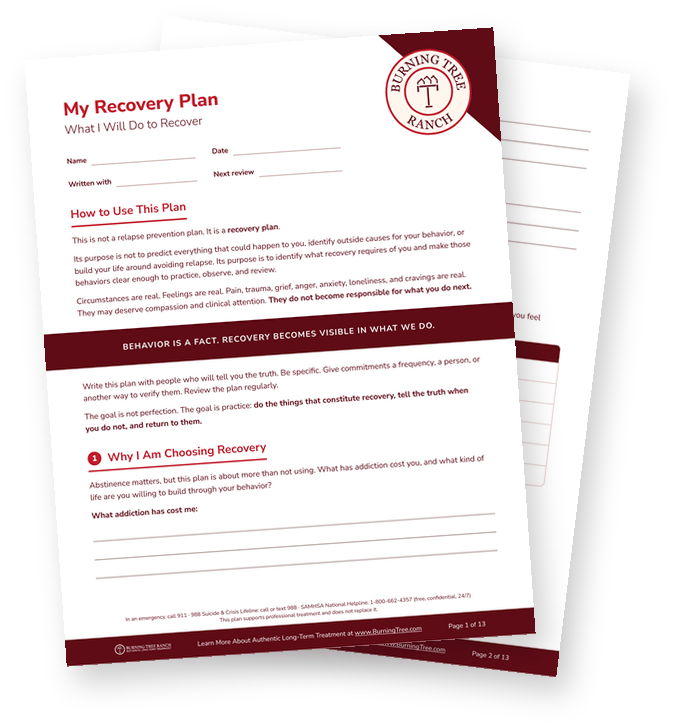
A printable, fillable recovery plan for the person in recovery and for the family, built to replace the usual relapse prevention plan template.
Why a Recovery Plan Instead of a Relapse Prevention Plan
Recovery Is the Plan
I don’t want to build someone’s recovery around everything outside of them that might supposedly cause them to relapse. I want to know what they’re doing.
Are you going to meetings? Are you working with a sponsor? Are you telling the truth? Are you following clinical recommendations? Are you taking prescribed medication as directed? Are you accountable? Are you working the steps? Are you making amends? Are you keeping commitments? Are you accepting consequences? Are you doing the things you agreed to do when nobody is watching?
In other words: Are you recovering?
That’s the question. People either do the things necessary for their recovery or they don’t. A worksheet doesn’t change that.

I Don’t Believe in Triggers
I don’t use the word trigger to explain relapse because I believe that language puts too much causal power outside the person.
A divorce didn’t make someone drink. An argument didn’t make someone use. A difficult parent didn’t make someone relapse. A bad day didn’t make someone relapse. Being angry, lonely, rejected, or afraid didn’t make someone relapse.
Those things happened. Then the person behaved.
Those are two different facts.
If we aren’t careful, we draw an arrow between the two and call the first thing the cause of the second. I don’t.
Something happening before a behavior does not make it responsible for the behavior.
The circumstances may be painful. The emotions may be enormous. The craving may be intense. The history may be tragic. All of it may deserve compassion and clinical attention. But none of it gets to decide what the person does next.
This doesn’t mean circumstances don’t matter. It means responsibility doesn’t move. We can have enormous compassion for what happened to someone while staying clear about what that person did next.
Recovery exists precisely because life will continue happening.
Behavior Is a Fact
One of the simplest principles I know is this: behavior is a fact.
Intentions aren’t. Promises aren’t. Potential isn’t. Explanations aren’t. What someone says they’ll do isn’t.
Behavior happened, or it didn’t. The meeting was attended, or it wasn’t. The sponsor was called or wasn’t. The appointment was kept or wasn’t. The truth was told, or it wasn’t. The medication was taken as prescribed, or it wasn’t. The commitment was kept, or it wasn’t. The person drank or didn’t. The person used or didn’t.
We can spend hours explaining the circumstances surrounding behavior, and sometimes that work is clinically important. But an explanation doesn’t alter the behavior.
Understanding why something happened does not require us to pretend something else happened.
Recovery Cannot Depend on Circumstances
Life is going to happen. People die. Marriages end. Jobs disappear. People get rejected. Parents disappoint their children. Children disappoint their parents. People become afraid, angry, lonely, anxious, depressed, disappointed, and overwhelmed.
Recovery cannot depend upon eliminating those experiences. If someone’s sobriety requires life to cooperate, that isn’t much of a recovery.
“What happened to you?” can be an important question. But eventually another question matters more:
What did you do?
And then:
What are you going to do now?
Recovery puts responsibility for that answer where it belongs.
Feelings Are Real. They Aren’t Instructions.
Anger is real. Fear is real. Grief is real. Craving is real. Loneliness is real. Anxiety is real. You don’t need to deny any of those experiences, but none of them has to become an instruction.
A person can be angry and go to a meeting. A person can be grieving and call a sponsor. A person can experience a craving and tell the truth about it. A person can be anxious and keep a commitment. A family member can be terrified and maintain a boundary. A parent can feel guilty and still refuse to rescue.
Recovery does not require the feeling to disappear before the behavior changes.

The Recovery Plan Should Be Boring
A good recovery plan probably isn’t particularly exciting. Much of recovery is repetitive: wake up, do what you said you would do, go where you said you would go, tell the truth, call the people you agreed to call, take prescribed medication, show up for work, participate in treatment, attend the meeting, work the steps, ask for help, and keep your commitments.
Then go to bed, wake up, and do it again.
People sometimes want a new answer because doing the old things consistently is difficult. But recovery is not primarily an information problem. Eventually, it becomes a behavior problem.
“If someone’s sobriety requires life to cooperate, that isn’t much of a recovery.”
Brook McKenzie, LCDC
Chief Executive Officer, Burning Tree Ranch
Knowing Is Not Doing
This becomes especially important with chronic relapse. After enough treatment, many people know exactly what they’re supposed to do. They know the language. They understand addiction. They can describe their family system and their trauma. They know the steps, meetings, and phone numbers. They can explain every previous relapse.
Some could probably teach the class.
And then they don’t do the things they know to do.
At that point, more information may be solving a problem they don’t have. Knowing is not doing.
That changes the clinical question. Instead of continuing to ask, “What doesn’t this person understand?” we need to ask:
Why aren’t they doing what they already understand?
For a chronic relapser, that distinction can change everything about treatment.
Another treatment episode cannot simply provide more information followed by another plan explaining how not to relapse.
The problem may be much simpler and much harder: they haven’t consistently done what recovery requires.
That is why treatment has to provide enough time, structure, accountability, clinical work, and repetition for different behavior to become observable.
Not promised. Not discussed. Not understood. Not intended.
Demonstrated.
Families Need Recovery Plans Too
Families can make the same mistake. They become consumed with figuring out what might make their loved one relapse: keep alcohol out of the house, don’t upset him, don’t mention that subject, make sure she isn’t alone, don’t let him get too stressed, watch who she spends time with, prevent the next crisis.
Manage the environment. Manage the emotions. Manage the person.
Soon the entire family is organizing itself around somebody else’s recovery.
I don’t believe that’s the family’s job.
The family has its own recovery to do.
Are we going to tell the truth? Maintain our boundaries? Stop rescuing? Allow consequences? Stop financing behavior we say we oppose? Seek support? Stop accepting explanations that contradict observable behavior? Stop doing things for another adult that belong to that adult?
That’s a family recovery plan.
Your Recovery Plan Cannot Be Their Recovery Plan
You cannot recover for somebody else. You cannot attend enough Al-Anon meetings to make your son sober. You cannot create a sufficiently perfect home environment to make your daughter recover. You cannot establish a sufficiently clever boundary to make your husband work the steps. You cannot prevent every painful experience, and you cannot love somebody into willingness.
Your responsibility is your recovery. Their responsibility is theirs.
That means a family’s recovery plan should describe the family’s behavior, not the addicted person’s.
Instead of “He has to attend three meetings every week,” the family might decide, “We will not continue providing housing when the conditions we established for providing housing are not being met.”
Instead of “She needs to stop lying,” the family might decide, “We will make decisions based on observable behavior rather than explanations we cannot verify.”
Instead of “He needs to become responsible,” the family might decide, “We will stop assuming responsibilities that belong to him.”
One attempts to control somebody else. The other defines my behavior.

Stop Taking Their Turn
Families become exhausted when they repeatedly perform responsibilities that belong to the person they love.
The person creates a problem, and the family solves it. The person runs out of money, and the family provides it. The person loses housing, and the family finds another apartment. The person damages a relationship, and the family explains. The person encounters a consequence, and the family removes it. The person doesn’t do something, and somebody else does it for them.
Everyone may call this helping because the intention is loving. But intention doesn’t determine outcome. Behavior does.
Sometimes the most useful thing a family can do is stop interrupting the information contained in consequences. Not angrily. Not vindictively. Not to teach somebody a lesson.
Simply because the responsibility belongs to someone else.
“You cannot love somebody into willingness.”
Brook McKenzie, LCDC
Chief Executive Officer, Burning Tree Ranch
Families Either Do Their Recovery or They Don’t
The standard isn’t complicated. Did you attend your meeting? Did you call your sponsor? Did you keep the boundary? Did you tell the truth? Did you refuse to participate in the chaos? Did you allow an adult to experience an adult consequence? Did you stop making threats you aren’t prepared to enforce? Did you seek help for yourself? Did you stop trying to control something that isn’t yours to control?
Did you do what you said you were going to do?
This is where recovery becomes remarkably clear. Not easy. Clear.
People and families either do the things that constitute recovery or they don’t.

How to Write a Recovery Plan
What Goes in a Recovery Plan?
Don’t write a list of everything in the world that might supposedly cause you to relapse. Write down what recovery requires from you.
Your recovery plan should answer these questions:
- What will you do every day and every week?
- Who will you remain accountable to?
- What treatment recommendations will you follow?
- What does honesty look like?
- What does responsibility look like?
- What commitments will you keep?
- What belongs to you that other people have historically done for you?
- What behaviors will demonstrate that you’re participating in your own recovery?
Then do those things.
The family should write its own plan, and it should answer these questions:
- What will we do?
- What will we stop doing?
- What responsibilities belong to us?
- What responsibilities don’t?
- What financial support will we provide or not provide?
- What boundaries will we maintain?
- What behavior will we no longer participate in?
Then the family does those things.
Two recovery plans. One for the individual. One for the family. Neither should try to control the other.
Our free workbook walks through both plans, one section at a time, with room to write your answers.
A printable, fillable recovery plan for the person in recovery and for the family, built to replace the usual relapse prevention plan template.
What Happens When Someone Stops Doing Their Recovery?
Return to the facts.
Don’t predict. Don’t diagnose intentions. Don’t argue about explanations. Don’t look outside the person for something to blame.
Ask one question:
Is this person doing the things they identified as necessary for their recovery?
Yes or no.
If the answer repeatedly becomes no, that is information. Respond to the information.
The same applies to the family. Did we abandon our boundary? Did we rescue again? Did we provide money we said we wouldn’t provide? Did we assume a responsibility that didn’t belong to us?
Tell the truth about it and return to recovery.
The objective isn’t perfection. It’s practice.
Stop Building Life Around Relapse
This is ultimately why I don’t believe in relapse prevention plans.
They put relapse at the center.
I don’t want relapse at the center.
I don’t want someone waking up every morning trying not to use drugs. I want them waking up and doing recovery.
And I don’t want families waking up every morning trying to prevent somebody they love from relapsing. I want them doing their recovery too.
Tell the truth. Accept responsibility. Maintain boundaries. Seek help. Allow consequences. Keep commitments. Practice principles. Do what belongs to you. Stop doing what belongs to someone else.
Then wake up tomorrow and do it again.

I don’t believe the answer to relapse is a better relapse prevention plan.
I believe the answer is recovery.
I don’t believe something outside of us gets to become responsible for our behavior because we call it a trigger. Circumstances are real. Feelings are real. Pain is real. Trauma is real. Cravings are real.
Responsibility remains.
For the addicted person, recovery means doing the things recovery requires. For the family, recovery means doing the things family recovery requires.
You don’t have to predict the next relapse. You don’t have to identify everything that could supposedly cause one. You don’t have to know what somebody is thinking. You don’t have to argue about intentions. You don’t have to manage another adult’s environment.
Look at the behavior.
Are you doing the things that constitute recovery?
Yes or no.
That’s the question.
And that’s the plan.
Questions Families Ask About Relapse Prevention Plans
What Is a Relapse Prevention Plan?
A relapse prevention plan is a written plan, often completed before someone leaves treatment, that names a person’s triggers, warning signs, and high-risk situations and lists what they will do when those come up. We use recovery plans instead, because a plan built around relapse keeps relapse at the center.
What Is the Difference Between a Relapse Prevention Plan and a Recovery Plan?
A relapse prevention plan describes what might cause a relapse and how to avoid it. A recovery plan describes what the person will do: the meetings they attend, the sponsor they call, the clinical recommendations and prescribed medication they follow, the commitments they keep, and who can verify each one. Because behavior is a fact, the answer to whether someone is following a recovery plan is yes or no.
Is There a Free Relapse Prevention Plan PDF or Template?
Yes. Our recovery plan workbook is free, printable, and fillable, and it works as a relapse prevention plan template built around recovery instead of relapse. It covers daily and weekly commitments, an accountability circle, health and clinical responsibilities, what to do when recovery behaviors stop, and a section the family completes on its own. Write it with people who will tell you the truth.
Should Families Write Their Own Recovery Plan?
Yes. A family’s recovery plan describes the family’s behavior, not the addicted person’s: the boundaries you will keep, what you will stop doing, what financial support you will or will not provide, and where you will get support of your own, such as Al-Anon, Families Anonymous, therapy, or a family program. Neither plan should try to control the other.
We Have Written Relapse Prevention Plans Before. Why Didn’t They Work?
For a chronic relapser, more information is rarely what is missing. After several programs, most people know exactly what they are supposed to do; the gap is doing it consistently. That takes treatment with enough time, structure, and accountability for different behavior to become observable, which is what long-term treatment at Burning Tree is built for.